
One of the first decisions you make when starting a business is what to call it. It’s also one of the most important, and one of the most misunderstood.
The instinct for most new business owners is to pick a name that describes what they do. It feels logical. If you sell coffee, put “coffee” in the name. If you do taxes, lead with “tax.” Lawyer? You guessed it, throw the word “law” in there. It makes sense from a marketing standpoint too right?
But what about from a trademark/branding standpoint? The problem is that descriptive names make for weaker trademarks, and weaker trademarks are harder to protect.
The brands that have built some of the most recognizable names in the world didn’t go the descriptive rought.
- Apple® doesn’t sell apples.
- Nike® doesn’t describe shoes.
- Amazon® started off as an online bookstore, but the word has nothing to do with books.
That distance between the name and the product isn’t random. It’s strategic.
Let’s talk about why.
The Categories of Trademark Strength
When determining whether or not to issue a trademark, the U.S. Patent and Trademark Office (“USPTO”) will identify if the mark is merely descriptive or not. Essentially, there are four basic types of trademarks, ranked from weakest to strongest: (1) generic, (2) descriptive, (3) suggestive, and (4) arbitrary/fanciful.
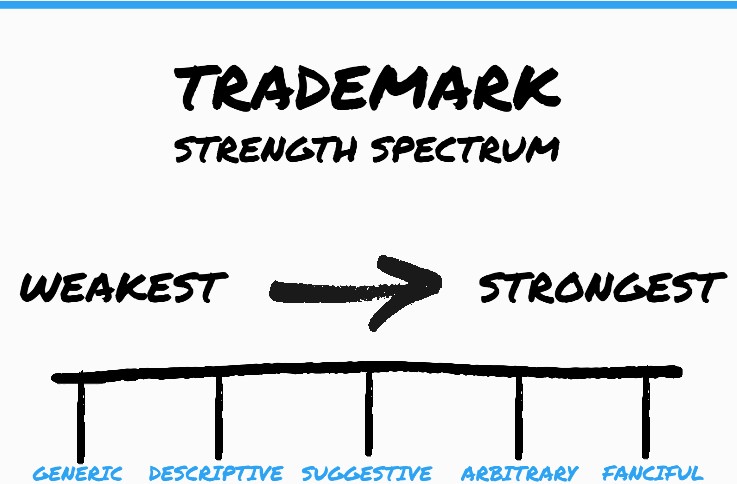
Generic Marks:
A mark will be considered generic if it simply names the goods or services that are being sold. You cannot register words like “coffee” for a coffee shop, “shoes” for shoes, or “law firm” for a law firm. Generic terms don’t function as trademarks and you would be hard pressed trying to enforce a generic name. A generic mark will not be granted a registration by the USPTO.
Descriptive Marks:
Descriptive marks describe a feature, quality, ingredient, or characteristic of the product or service.
Classic example: “Raisin Bran” for cereal with raisins and bran. The USPTO refused it because it merely described what was in the box.
Descriptive names tell customers exactly what you do. That feels good from a marketing standpoint, but, legally? It’s weaker.
The good news is that descriptive marks can be registered if they acquire what’s called “secondary meaning.” That means the public has come to associate that descriptive term with a single source. Getting to that point takes time and money and you might ultimately end up with little or no protection.
Suggestive Marks (The Sweet Spot for Many Businesses)
That brings us to suggestive marks. Somewhere in the middle on the trademark strength spectrum and a step in the right direction. These types of marks require a bit more thought. They hint at what you do, but they don’t directly describe it. They require a small “mental leap.”
Examples of suggestive marks include Chicken of the Sea (for tuna) and Coppertone (for sunscreen). You can see the connection, but it’s not quite as literal as you would find in a descriptive mark.
Suggestive marks are strong enough to register and enforce, while still giving customers a sense of what you do.
Arbitrary & Fanciful Marks (The Strongest)
Top of the food chain. These are the strongest types of trademarks. An arbitrary mark is a real word used in a totally unrelated context. Think Apple® for computers/phones and Amazon® for an online marketplace. A fanciful mark is a completely made up word like Kodak®, Xerox® and Verizon®.
No one else has a legitimate reason to use these terms in that space. That’s why they are easier to register (if unique) and hold greater weight when you try to enforce them. From a legal standpoint, they’re powerful. From a branding standpoint? They require more work upfront because they don’t explain what you, but once the brand catches on, they’re gold.
So What Should You Do When Naming Your Business?
If we’re speaking purely from a trademark strategy standpoint, arbitrary or fanciful is where you want to be to make sure you have the strongest type of trademark. With that said, not every business wants to start from zero and educate the market on what their name means.
What you want to avoid is this:
- You fall in love with a name.
- You buy the domains.
- You design your perfect logo.
- You invest in marketing.
- Then you find out the USPTO won’t register it because it’s descriptive, or you can’t stop competitors from using something nearly identical.
Even worse, you receive a cease and desist from a company who already has a registered trademark on the name operating in a similar space. That’s an expensive lesson you should try to avoid.
Your company name isn’t just branding. It’s a legal asset and the foundation that your entire business is built on. It’s worth slowing down and getting it right.
The Most Expensive Time to Fix Your Name Is After You Launch
I have this conversation more often than I would like with business owners who have already invested thousands into their branding, only to learn that their name is descriptive, unavailable, or both. You don’t need to guess where your name falls on the spectrum.
I can help. Book a free consultation below.